

Last Updated: November 4, 2026
Quick Summary
An ergonomic horse bridle is a headpiece shaped to follow the horse's head, with a contoured crown, curved cheek pieces and a repositioned browband that spread pressure away from the poll and clear of the eyes and ears. Because "ergonomic" has no single industry definition, the fit and construction matter more than the label.
- Wide, contoured crowns spread force over a larger area and lower peak pressure at the poll.
- Padding must stay soft enough to conform, since flat foam stops protecting the poll.
- Check the crown by pressing two fingers under it behind the ears while the bridle is on.
- Make sure two fingers fit under the noseband before riding.
- Re-measure and inspect the bridle monthly, because leather stretches and padding wears.
Table of Contents
- What Is an Anatomical Bridle and How Does It Differ?
- Pressure Points and the Horse's Poll: Why Design Matters
- Benefits of an Anatomical Bridle No Flash Design for Sensitive Horses
- Bit Stability, Contact Consistency and Lateral Work
- Scientific Evidence vs. Anecdotal Claims
- Long-Term Musculoskeletal Impact, Breed Differences and Material Longevity
- Is the Gentlest Bridle for a Horse an Ergonomic One? How to Choose and Fit Yours
- Frequently Asked Questions
What Is an Anatomical Bridle and How Does It Differ?
An anatomical bridle is a headpiece built around the shape of the horse's head rather than a flat strap pattern. Ergonomic horse bridle designs are a practical starting point for riders who want more comfort at the poll, the cheekbones and the noseband. The ergonomic horse bridle category covers several design approaches, so it helps to know what you are actually buying.
Traditional bridles use straight cheek pieces and a crownpiece that runs in a fixed line behind the ears. Anatomical designs curve the cheek pieces, pad the crown and reposition the browband so it sits clear of the eyes and ears. Some riders choose them because the headpiece is shaped to follow the contours of the horse's head.
Keep in mind that "ergonomic" is a marketing term without a single industry definition. Two bridles marketed the same way can differ noticeably in padding, cut and adjustment range. Compare the construction, not just the label.
Pressure Points and the Horse's Poll: Why Design Matters
The poll is the bony ridge between the horse's ears, formed by the occipital bone at the top of the skull.
Pressure at the poll is a function of three variables: contact area, padding compliance and strap angle. A narrow crown concentrates the same downward force on a smaller patch of skin and subcutaneous tissue, which is why a thin, unpadded crownpiece can produce a hard, localized pressure point. A wider, contoured crown spreads that force across a larger area and lowers the peak pressure on any one spot. Padding adds a second layer of distribution, but only if it stays in place, foam that compresses flat within a season stops doing its job.
The angle matters as much as the width. A crownpiece that runs in a straight line behind the ears tends to pull forward against the back of the ears and press the browband down toward the eye.
Watch out: a crown that is wide but rigid can create edge pressure along its borders, so check that the padding is soft enough to conform to the poll rather than sitting on it like a plank.
Pressure at the poll can also affect how a horse responds to the bit.
Facial nerve pressure is the other half of the picture.
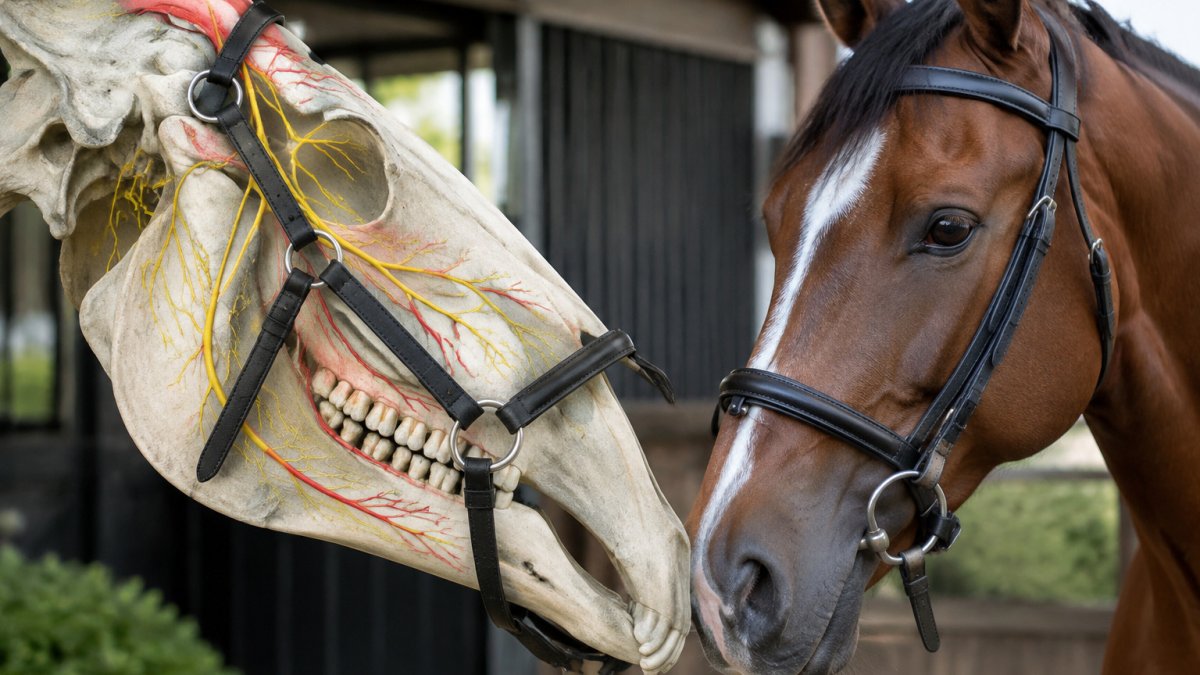
A useful way to think about it: every strap on a bridle is a trade-off between control and comfort. Ergonomic design does not remove that trade-off; it moves the load onto structures better able to carry it.
The article's key fit factors that determine poll pressure can be compared at a glance:
| Factor | What to check | Why it matters |
|---|---|---|
| Contact area | Wide, contoured crown | Spreads force over a larger patch |
| Padding | Soft enough to conform | Plank-like padding concentrates pressure |
| Strap angle | Curve behind ear base | Avoids pressing the browband onto the eye |
| Field test | Two fingers under crown | Reveals hard seams or collapsed padding |
Benefits of an Anatomical Bridle No Flash Design for Sensitive Horses
Some riders with sensitive horses look for a bridle without a flash noseband, meaning one that does not sit across the nose.
Not every sensitive horse reacts the same way, and a no-flash design will not fix every behavior problem. Still, the benefit is simple to test. Fit the bridle, observe the horse on a few rides and watch for changes in head carriage and willingness to accept the bit.
A common mistake is buying a gentle design and then fitting it too tightly. Even a well-designed bridle causes discomfort if the noseband is cinched down. Check that you can comfortably slide two fingers under the noseband before you ride.
Bit Stability, Contact Consistency and Lateral Work
Fit affects how the bit sits in the mouth, and how the bit sits affects contact. A browband that rides too low or cheek pieces that shift during lateral work can change the stability of the bit and make your rein aids less consistent. For a related check on how tack sits, see how to size the girth correctly: Choose the Right Saddle Girth Length.
When you test a new bridle, pay attention to how the bit settles during transitions and turns. If the bridle moves around the head or the bit slides, the fit needs adjustment before the bridle is ready for regular schooling.
Riders focused on lateral movement often find that the cheek pieces and browband matter as much as the bit itself. Take time to set each adjustment and recheck it after a warm-up.
Scientific Evidence vs. Anecdotal Claims
Much of what is written about ergonomic bridles comes from manufacturers and rider testimonials. Those accounts can be useful, but they are not the same as controlled research on equine comfort.
Veterinary and equine biomechanics research on tack design is limited. We cannot point you to a body of studies that proves one bridle shape is better for every horse. What we can say is that poll pressure, noseband tension and browband position are established fit factors that riders and trainers consistently watch.
Treat claims of dramatic improvement with caution. Look for specific, observable changes you can check yourself, and ask your veterinarian or a qualified saddle fitter if your horse shows persistent resistance or discomfort.
Long-Term Musculoskeletal Impact, Breed Differences and Material Longevity
A harder question is what a bridle does to the horse over months and years of consistent work. That is where ergonomic design earns or loses its case.
The long-term musculoskeletal picture
Repeated low-grade pressure at the poll and across the nasal bones does not produce an obvious injury the way a tendon strain does. Instead, it produces a pattern. Some horses may develop persistent tension in the muscles at the top of the neck and behind the jaw, or reduced willingness to stretch down into the contact.
The temporomandibular joint (TMJ), the jaw joint just below and in front of the ear, is the structure most often discussed in this context. It sits close to where the crownpiece and cheek pieces meet, and pressure or asymmetry in that region is one reason some practitioners recommend checking bridle fit when a horse shows resistance to bending or difficulty chewing.
Symmetry deserves its own note. A bridle that is adjusted tighter on one side, or whose cheek pieces are different lengths, loads the head unevenly with every stride. Over time that asymmetry can show up as a consistent head tilt, a stiffer bend to one side or uneven rein contact.
Breed-specific head morphology
Head shape varies enormously across breeds, and a design that fits one type can sit badly on another. Arabian and part-Arabian horses typically have a shorter, finer head with a dished profile, a wide forehead and a relatively prominent jowl; a crownpiece sized for a larger head can ride forward onto the ears, and a noseband can sit too close to the cheekbone. Warmbloods and draft crosses tend to have longer, broader heads with more space between the ears, which means a narrow crown may concentrate pressure at the poll even when the sizing chart says the bridle fits.
A practical approach is to measure four things before you shop: the width between the ears, the distance from the poll to the corner of the mouth, the circumference of the nose at the noseband line, and the browband length across the forehead. Compare those numbers to the manufacturer's chart rather than to a generic size label, and expect to adjust at least one strap on any new bridle. If your horse has a very wide forehead or a pronounced jowl, look for a browband with a shaped curve and a crown with a relief cut behind the ears rather than a straight strap.
Material longevity and fit drift
Ergonomic designs often use more complex padding and shaping than traditional bridles, which can affect maintenance. Leather stretches with use and sweat, and a crownpiece that fit snugly when new can loosen enough over a season to shift the browband forward. Synthetic padding may hold its shape longer but can crack or delaminate at the seams.
Inspect the bridle monthly: run a thumb along the crown padding to feel for compressed or hardened spots, check the stitching at the cheek-piece buckles, and look for cracks where the leather bends.
Watch out: a bridle that has stretched will often still look fine on the rack, so re-measure the crown and noseband at the start of each show season rather than trusting last year's adjustment.
Taken together, these three factors, long-term loading, head shape and material wear, are why ergonomic bridle design is better understood as a fit-and-maintenance discipline than as a single product feature. The design gives you a better starting point; the measurements and the monthly inspection are what keep it working.
Is the Gentlest Bridle for a Horse an Ergonomic One? How to Choose and Fit Yours
The gentlest bridle for a horse is generally the one that fits correctly, not automatically the most expensive or most heavily marketed design. Fit and adjustment matter more than any single feature.
Start with measurement. Measure the crown, the cheek pieces and the noseband against your horse's head, then compare them to the sizing guide. Next, fit the bridle with the bit in place and check that the browband clears the ears and eyes. Finally, ride a short session and recheck the fit afterward.
Here is a simple checklist to use when you shop:
- Crownpiece is padded and wide enough to spread pressure at the poll
- Browband clears the ears and eyes
- Noseband allows two fingers underneath
- Cheek pieces adjust independently
- Sizing matches your horse's measurements
If you want help narrowing the field, browse our current selection of bridles at Horsey Horse Store and compare the construction details listed on each product page.
Frequently Asked Questions
Do anatomical bridles make a difference?
Some riders find that an anatomical bridle may feel more comfortable for their horse, particularly around the poll, cheekbones and nose. Individual results vary with the horse's head shape, sensitivity and the rider's hands. Evidence from controlled studies is limited, so the most reliable test is observation: watch for reduced head tossing, smoother bit contact and a relaxed jaw over several rides. Fit matters as much as design, so an ill-fitting anatomical bridle can cause the same problems as a conventional one.
What is the gentlest bridle for a horse?
There is no single gentlest bridle for every horse. A bridle with a padded crown, a wide noseband that does not sit on the cheekbones, and cheek pieces that clear the eyes is usually easier on sensitive horses. Anatomical and ergonomic designs are often chosen for this reason. Start with the bridle that fits the horse's head shape, then adjust the noseband and browband so each piece sits without pinching or rubbing.
How should an anatomical bridle fit?
A well-fitted anatomical bridle sits level behind the ears with the padded crown resting clear of the poll. The browband should lie flat without wrinkling and should not touch the eyes. The noseband should allow two fingers to fit underneath, and the cheek pieces should sit without pulling the bit into the mouth. Recheck the fit after the horse gains or loses weight, and whenever you change bits.
Can an ergonomic bridle reduce pressure on a horse's face?
An ergonomic bridle is designed to distribute pressure across broader areas of the head rather than concentrating it on the nerves and bony structures of the face. Designs that avoid the cheekbones and the facial nerve path are intended to reduce localized pressure. Results depend on correct fit and on the rider's hands, so pair a well-designed bridle with light, consistent contact and check the horse's reactions regularly.
