

Last Updated: November 2, 2026
Quick Summary
The best saddle rack for heavy Western saddles is one built for mass, width, and balance, since these saddles often weigh 30 to 45 pounds. Choose a wall-mounted rack for storage on a tack wall, or a folding or portable stand for tight rooms. Confirm the weight rating and mount it into studs or sound masonry.
- Heavy Western saddles can weigh 30 to 45 pounds, so rate the rack against the full loaded total.
- Add pads, breastcollar, and fenders, since one loaded station can reach 50 to 60 pounds.
- Rate the rack well above total static load to allow for dynamic forces when saddles are dropped or bumped.
- Mount wall racks into studs or sound masonry, not drywall alone, and use fasteners rated for the load.
- Test the mount with light pressure before loading a heavy Western saddle onto the rack.
Table of Contents
- How to Check Saddle Rack Weight Capacity Before You Buy
- Wall-Mounted Saddle Racks: The Space-Saving Choice
- Folding Saddle Racks for Tight Tack Rooms
- Portable Saddle Racks for Shows and Trailers
- Side-by-Side Comparison of Our Saddle Racks
- Choosing Your Heavy Western Saddle Rack Next
- Frequently Asked Questions
Heavy Western saddles can weigh 30 to 45 pounds, and a rack that works fine for a lightweight English saddle may bend, wobble, or fail under that load. A common mistake is buying a rack by its looks, then discovering it cannot carry a bulky horn-and-skirt saddle without sagging. The best saddle rack for heavy Western saddles is one built for mass, width, and balance. Below, we compare the saddle racks in our selection and explain what to check before you buy.
Quick Picks:
- Best for wall space: GOLASON 3-Tier Wall-Mounted Saddle Rack, a multi-tier design that stacks gear vertically
- Best for tight rooms: HDYEGY Folding Saddle Rack Stand, which folds flat when you need the floor
- Best for a full setup: VEVOR Wall-Mount Saddle Rack Set, sold as an eight-piece kit
- Best for portability: Wood Saddle Rack Stand, a single freestanding piece that moves with you
Heavy Western saddles are not just big. Their wide, flat seats and deep trees put weight in places a light English saddle never reaches. A rack needs wide, supportive contact points, a sturdy base or mount, and enough clearance that the horn and fenders do not catch on anything. Many riders find that a rack designed for English saddles simply cannot hold the wider Western shape.
Watch out: A rack that looks sturdy on the shelf can still tip or pull loose once a heavy saddle is loaded, so test the setup before you walk away from it.
How to Check Saddle Rack Weight Capacity Before You Buy
A published weight rating is a starting point, not a guarantee. The number that matters is the total load you will actually hang on the rack, and that load is almost always higher than the saddle alone.
Step 1: Add up the real load. Weigh the saddle, then add every item that will live on the rack at the same time. Do not rate the rack against the bare saddle. If the rack has a pad bar, include the pads. If it has hooks, include the bridles and halters.
Step 2: Apply a safety margin. Static load is only half the story. Dropping a saddle onto the rack, leaning on it while you cinch up, or bumping it in a narrow aisle creates a dynamic load that can briefly double the force on the frame and fasteners.
Step 3: Read the frame, not the finish. Thicker steel tube, welded joints, and solid hardwood hold load better than thin wire or stamped light-gauge metal. Look at where the rack meets the wall or floor: a wide base or a backplate that spans two studs spreads force far better than a single narrow bracket.
Step 4: Match the fastener to the load. The strongest rack will fail if it is held by two drywall screws. The fastener, not the rack, is often the weakest link. The table below shows the working load you can reasonably expect from common mounting hardware; use it to sanity-check any installation before you load a saddle.
| Fastener and wall type | Typical working load per fastener | Best use |
|---|---|---|
| 1/4-inch lag bolt into a wall stud | 80 to 100 pounds | Standard wall-mounted saddle racks |
| 3/8-inch lag bolt into a wall stud | 150 to 200 pounds | Multi-tier racks and heavy Western saddles |
| 3/16-inch toggle bolt in 1/2-inch drywall | 30 to 50 pounds | Light items only; not for loaded saddles |
| 1/4-inch sleeve anchor in concrete or masonry | 100 to 150 pounds | Concrete barn walls and block |
| 3/8-inch wedge anchor in concrete | 200 pounds and up | Heavy multi-saddle racks |
These are conservative working figures for sound material, not laboratory maximums. Old or cracked studs, crumbly mortar, and thin paneling reduce them further.
Step 5: Test before you trust. Mount the rack, then load it gradually. Hang a light saddle first, press down firmly on the frame, and watch for flex at the bracket, movement at the fastener, or any creak from the wall. If anything shifts, stop and reinforce the mount before adding a heavy Western saddle.
Watch out: A rack rated for 100 pounds on a concrete wall can still pull out of drywall if the installer uses the wrong anchors, so confirm the fastener rating matches the wall before the saddle goes up.
Wall-Mounted Saddle Racks: The Space-Saving Choice
Wall-mounted racks are the most efficient option when floor space is limited. They lift the saddle off the ground, keep it out of the way, and free the floor for grooming and feed storage. For a heavy Western saddle, a wall mount should hold the saddle close to the wall with a secure cradle and spread the load across at least two studs.
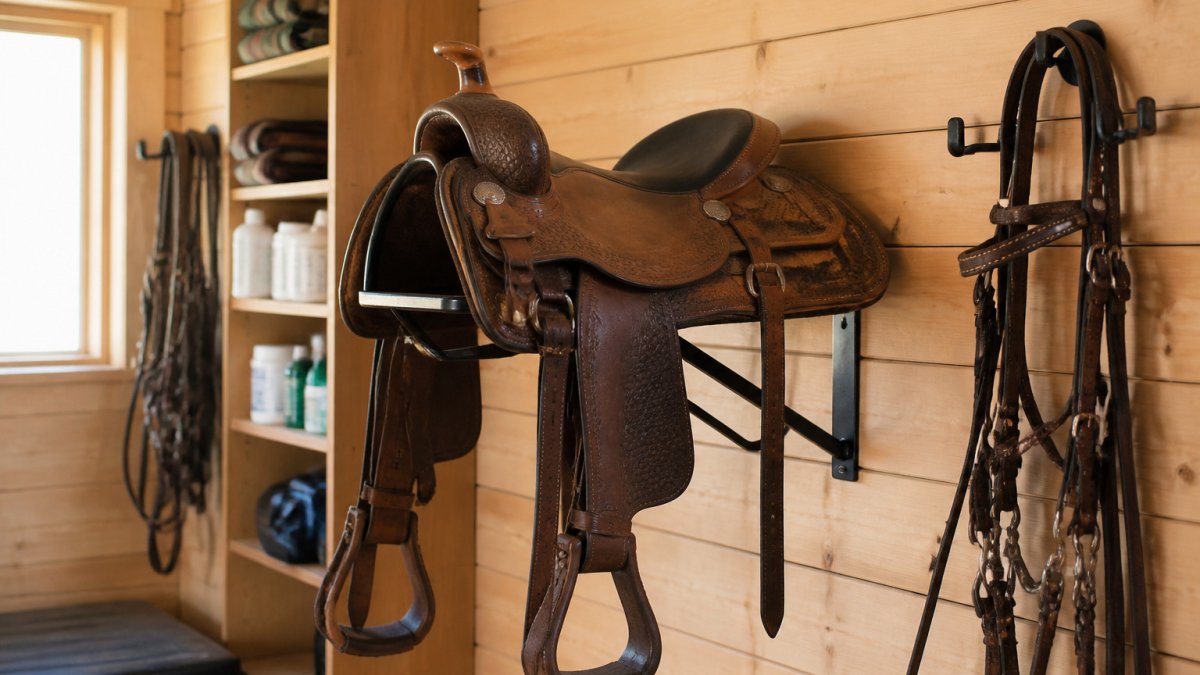
The GOLASON 3-Tier Wall-Mounted Saddle Rack is a multi-tier design that stacks gear vertically. Priced at $164.99, it suits a dedicated tack wall. The VEVOR Wall-Mount Saddle Rack Set, priced at $462.87, is sold as an eight-piece set, which makes sense for a barn managing several saddles at once. The Paterr Wall-Mount Saddle Rack Set, priced at $148.99, is sold as two pieces.

Best for: riders with a dedicated tack wall who want to store several saddles vertically. Skip if: you have a single saddle and a small room, where a freestanding rack is simpler.
Mounting Into Studs Versus Masonry
How you mount the rack matters as much as the rack itself. The wall decides the hardware, and the hardware decides whether a heavy Western saddle stays up.
Wood-stud walls. Find the studs with a stud finder and mark both edges. Fasten wall-mounted racks into wall studs wherever possible, since studs carry far more load than drywall alone.
Masonry and concrete walls. Use sleeve anchors or wedge anchors rated for the load, and drill into the concrete or block itself rather than the softer mortar joints. In hollow block, use specialized block anchors that expand behind the block face.
GOLASON 3-Tier Wall-Mounted Saddle Rack →
Drywall-only walls. Standard drywall alone is not a safe mounting surface for a loaded Western saddle. Toggle bolts can hold light items, but a 50-pound loaded station creates dynamic forces that pull toggles through drywall over time. If no studs are available, install a floor-to-ceiling mounting board or a freestanding rack instead.
Clearance and lifting height. A Western saddle is wide, and its horn and fenders need room. Mount the lowest cradle at roughly hip height, around 36 to 42 inches from the floor, so you can lift the saddle on and off without twisting.
Saddle-tree-friendly support. The contact points matter as much as the mount. A cradle or pad bar that supports the saddle along the bars of the tree, rather than pressing on the seat or the skirts, helps prevent pressure marks, stretched leather, and a distorted tree over time.
Always test the mount with light pressure before loading a saddle. If the rack flexes or the anchors shift, stop and reinforce the installation.
Watch out: A rack mounted only into drywall with toggle bolts can look solid on day one and still pull through after months of loading a heavy Western saddle, so confirm the fastener reaches a stud, a mounting board, or sound masonry.
Folding Saddle Racks for Tight Tack Rooms
Folding racks suit small rooms, shared spaces, and riders who need the floor back at the end of the day. The HDYEGY Folding Saddle Rack Stand, measuring 28 by 19 by 37.5 inches and priced at $124.99, is a folding rack for English and Western saddles.

Before you buy a folding rack, confirm that its footprint fits the saddle, and that the locking mechanism holds firmly when the rack is open. A folding design is only as strong as its hinges, so check them carefully.
Best for: small tack rooms and riders who want floor space back after each session. Skip if: you need to carry a very heavy saddle daily, since a lighter frame may flex under sustained use.
Portable Saddle Racks for Shows and Trailers
Portable racks are useful at horse shows, clinics, and trailer setups, where you need a stable place to set a saddle without mounting anything to a wall. The Wood Saddle Rack Stand, priced at $130.99, is a wood rack. Because no exact dimensions are published on its listing, compare the photos carefully and confirm the fit for your saddle before checkout.

A portable rack should be heavy enough to resist tipping on uneven ground. When you pack one for a trailer, secure it so it cannot shift during transport.
Best for: riders who move between barns, shows, and trailers. Skip if: you need a permanent setup that stays put and uses wall space efficiently.
Side-by-Side Comparison of Our Saddle Racks
The table below summarizes the five racks we carry. Prices are the listed prices in USD. Free shipping applies on orders over $25, with 30-day returns on clean, unused items.
| Rack | Type | Listed Price | Best For |
|---|---|---|---|
| GOLASON 3-Tier Wall-Mounted Saddle Rack | Wall-mounted, 3-tier | $164.99 | Vertical storage on a tack wall |
| HDYEGY Folding Saddle Rack Stand | Freestanding, folding | $124.99 | Tight rooms and floor space |
| VEVOR Wall-Mount Saddle Rack Set | Wall-mounted, 8-piece set | $462.87 | Storing several saddles at once |
| Wood Saddle Rack Stand | Freestanding, wood | $130.99 | Portable and show use |
| Paterr Wall-Mount Saddle Rack Set | Wall-mounted, pad bar | $148.99 | Keeping saddle and pads together |
Measure your saddle, your wall or floor space, and your load before choosing. Each rack suits a different setup, and the right one depends on where you store your gear.
Choosing Your Heavy Western Saddle Rack Next
Start with your space. If you are still deciding on your overall setup, you can compare two popular horse breeds for beginners before you commit. If you have a wall, a wall-mounted rack gives the most storage for the least floor area. If your room is tight or you move between locations, a folding or portable stand fits better. Then confirm the weight rating, check the frame, and plan the mounting before you buy.
Shop the GOLASON 3-Tier Wall-Mounted Saddle Rack, the VEVOR Wall-Mount Saddle Rack Set, the HDYEGY Folding Saddle Rack Stand, the Wood Saddle Rack Stand, or the Paterr Wall-Mount Saddle Rack Set at Horsey Horse Store.
Frequently Asked Questions
What type of saddle rack is best for a heavy Western saddle?
A sturdy wall-mounted or freestanding rack with a wide, padded saddle bar usually works best for a heavy Western saddle. Look for a steel or heavy-duty wood frame and a rack rated to carry the full weight of your saddle plus tack. Wall-mounted racks save floor space, while freestanding models avoid drilling into walls. Choose based on your tack room layout and whether your wall can take the load securely.
How much weight can a Western saddle rack hold?
Weight capacity varies by model and construction, so check the listed rating before buying. Heavy Western saddles often weigh 30 pounds or more, so a rack should carry that load with margin to spare. Confirm whether the rating applies to a single arm or the whole unit. Mounting hardware and wall type also affect how much weight the setup can safely hold over time.
Can a folding saddle rack safely hold a heavy Western saddle?
Some folding racks handle heavy Western saddles well, but stability depends on the frame and locking mechanism. Choose a model with a wide base, a locking hinge, and a load rating that covers your saddle. Folding racks are easiest to store, yet they are less rigid than permanent wall units, so avoid overloading them. Test stability with your saddle before leaving it unattended.
How do I mount a saddle rack securely to a wall?
Mount the rack into wall studs or solid backing whenever possible, using hardware sized for the rack's listed load. Drywall anchors alone are not suitable for a heavy saddle. Mark the stud locations, drill pilot holes, and confirm the rack is level before loading it. Recheck the fasteners periodically, especially after moving a heavy saddle on and off the rack.
